Spencer Lewis

Installation view, Spencer Lewis & Markus Lüpertz: Nebelstreif, Vito Schnabel Gallery, St. Moritz, Switzerland, 2026; © Markus Lüpertz Artists Rights Society (ARS), New York / VG Bild-Kunst, Bonn; © Spencer Lewis; Photos by Stefan Altenburger; Courtesy the artists and Vito Schnabel Gallery
Installation view, Spencer Lewis & Markus Lüpertz: Nebelstreif, Vito Schnabel Gallery, St. Moritz, Switzerland, 2026; © Markus Lüpertz Artists Rights Society (ARS), New York / VG Bild-Kunst, Bonn; © Spencer Lewis; Photos by Stefan Altenburger; Courtesy the artists and Vito Schnabel Gallery
Installation view, Spencer Lewis & Markus Lüpertz: Nebelstreif, Vito Schnabel Gallery, St. Moritz, Switzerland, 2026; © Markus Lüpertz Artists Rights Society (ARS), New York / VG Bild-Kunst, Bonn; © Spencer Lewis; Photos by Stefan Altenburger; Courtesy the artists and Vito Schnabel Gallery
Installation view, Spencer Lewis & Markus Lüpertz: Nebelstreif, Vito Schnabel Gallery, St. Moritz, Switzerland, 2026; © Markus Lüpertz Artists Rights Society (ARS), New York / VG Bild-Kunst, Bonn; © Spencer Lewis; Photos by Stefan Altenburger; Courtesy the artists and Vito Schnabel Gallery
Installation view, Spencer Lewis & Markus Lüpertz: Nebelstreif, Vito Schnabel Gallery, St. Moritz, Switzerland, 2026; © Markus Lüpertz Artists Rights Society (ARS), New York / VG Bild-Kunst, Bonn; © Spencer Lewis; Photos by Stefan Altenburger; Courtesy the artists and Vito Schnabel Gallery
Installation view, Spencer Lewis & Markus Lüpertz: Nebelstreif, Vito Schnabel Gallery, St. Moritz, Switzerland, 2026; © Markus Lüpertz Artists Rights Society (ARS), New York / VG Bild-Kunst, Bonn; © Spencer Lewis; Photos by Stefan Altenburger; Courtesy the artists and Vito Schnabel Gallery
Installation view, Spencer Lewis & Markus Lüpertz: Nebelstreif, Vito Schnabel Gallery, St. Moritz, Switzerland, 2026; © Markus Lüpertz Artists Rights Society (ARS), New York / VG Bild-Kunst, Bonn; © Spencer Lewis; Photos by Stefan Altenburger; Courtesy the artists and Vito Schnabel Gallery
Installation view, Spencer Lewis & Markus Lüpertz: Nebelstreif, Vito Schnabel Gallery, St. Moritz, Switzerland, 2026; © Markus Lüpertz Artists Rights Society (ARS), New York / VG Bild-Kunst, Bonn; © Spencer Lewis; Photos by Stefan Altenburger; Courtesy the artists and Vito Schnabel Gallery
Installation view, Spencer Lewis & Markus Lüpertz: Nebelstreif, Vito Schnabel Gallery, St. Moritz, Switzerland, 2026; © Markus Lüpertz Artists Rights Society (ARS), New York / VG Bild-Kunst, Bonn; © Spencer Lewis; Photos by Stefan Altenburger; Courtesy the artists and Vito Schnabel Gallery
Installation view, Spencer Lewis & Markus Lüpertz: Nebelstreif, Vito Schnabel Gallery, St. Moritz, Switzerland, 2026; © Markus Lüpertz Artists Rights Society (ARS), New York / VG Bild-Kunst, Bonn; © Spencer Lewis; Photos by Stefan Altenburger; Courtesy the artists and Vito Schnabel Gallery
Installation view, Spencer Lewis & Markus Lüpertz: Nebelstreif, Vito Schnabel Gallery, St. Moritz, Switzerland, 2026; © Markus Lüpertz Artists Rights Society (ARS), New York / VG Bild-Kunst, Bonn; © Spencer Lewis; Photos by Stefan Altenburger; Courtesy the artists and Vito Schnabel Gallery
Installation view, Spencer Lewis & Markus Lüpertz: Nebelstreif, Vito Schnabel Gallery, St. Moritz, Switzerland, 2026; © Markus Lüpertz Artists Rights Society (ARS), New York / VG Bild-Kunst, Bonn; © Spencer Lewis; Photos by Stefan Altenburger; Courtesy the artists and Vito Schnabel Gallery
Installation view, Spencer Lewis & Markus Lüpertz: Nebelstreif, Vito Schnabel Gallery, St. Moritz, Switzerland, 2026; © Markus Lüpertz Artists Rights Society (ARS), New York / VG Bild-Kunst, Bonn; © Spencer Lewis; Photos by Stefan Altenburger; Courtesy the artists and Vito Schnabel Gallery
Installation view, Spencer Lewis & Markus Lüpertz: Nebelstreif, Vito Schnabel Gallery, St. Moritz, Switzerland, 2026; © Markus Lüpertz Artists Rights Society (ARS), New York / VG Bild-Kunst, Bonn; © Spencer Lewis; Photos by Stefan Altenburger; Courtesy the artists and Vito Schnabel Gallery
Installation view, Spencer Lewis & Markus Lüpertz: Nebelstreif, Vito Schnabel Gallery, St. Moritz, Switzerland, 2026; © Markus Lüpertz Artists Rights Society (ARS), New York / VG Bild-Kunst, Bonn; © Spencer Lewis; Photos by Stefan Altenburger; Courtesy the artists and Vito Schnabel Gallery


Vito Schnabel Gallery is pleased to present Nebelstreif, an exhibition bringing together works by Spencer Lewis and Markus Lüpertz at the gallery's St. Moritz location. On view from July 17 through September 5, the exhibition marks a rare dialogue between two painters united by a sustained investigation of space, surface, gesture, and the enduring possibilities of painting.
The exhibition’s title, Nebelstreif, which translates to ‘streak of fog’, drawn from Goethe’s 1782 poem Der Erlkönig, carries a double resonance: in the poem, it is the father’s word for what the child sees – a streak of mist, the rational explanation that fails to contain the uncanny. It also evokes the Maloja Schlange (Maloja Snake), the great ribbon of fog that descends through the Engadine valley toward St. Moritz – a phenomenon as local as it is elemental, and one that shares with both artists’ work that quality of resisting resolution, holding figuration and abstraction in a state of perpetual, charged ambiguity.
Long regarded as one of the most important artists of postwar Germany, Lüpertz has been a formative influence for younger generations of painters. Lüpertz’s work has had a profound influence on Lewis' practice – particularly his approach to pictorial structure and his ability to move fluidly between figuration and abstraction. Lewis' own engagement with painting draws on a broad lineage spanning German Expressionism, Surrealism, and Neo-Expressionism, and while the two artists may appear distinct in their immediate concerns, both ultimately transcend the categories most often applied to them. Gesture, materiality, and mark-making take precedence over representational distinctions.
The Lüpertz works on view draw their subjects from the German Romantic canon – from Wagner’s Ring Cycle to Goethe’s Erlkönig – though in each case Lüpertz resists direct illustration of his source, approaching myth and legend as raw material for pictorial reinvention rather than literal transcription. Rendered in layered passages of muted blues, greens, and warm flesh tones, the figures emerge from and dissolve back into a watery, light-suffused landscape across five canvases – the serial repetition less a narrative sequence than a cinematic accumulation, each painting deepening the same atmosphere of desire, ambiguity, and latent threat.
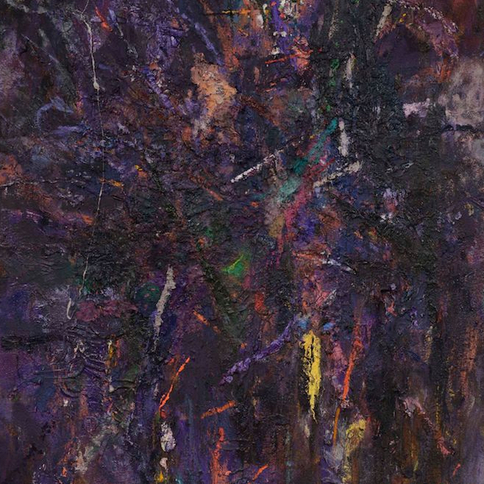
Lewis' paintings approach this territory differently. His practice has always carried figural suggestions – earlier compositions were developed at the scale of the body, their crossed structural armatures generating a vaguely anthropomorphic presence on the surface. In the works on view, that underlying logic has been absorbed into something denser and less resolved: layered passages of saturated color traversed by interlaced lines within which figural suggestion surfaces and withdraws. Where Lüpertz moves outward from a mythological subject toward painterly dissolution, Lewis builds from the body into abstraction – the figure present not as image but as residue, a structural memory embedded in the work's physical making.
For both artists, space is not something represented but something built. Lüpertz constructs pictorial worlds through the fragmentation and reassembly of historical and mythological motifs, while Lewis generates spatial tension through accumulations of paint and gestures. In each case, the canvas becomes a site where space emerges through the act of painting itself.
Equally significant is their shared engagement with surface. Lüpertz builds compositions through the accumulation of layers and material density; Lewis constructs paintings through processes of addition, erosion, and physical revision. The surface becomes an active site where image and material continually negotiate – not a fixed picture, but a record of transformation, where form is discovered through process and structural memory accrues.
Rather than presenting two distinct approaches to painting, the exhibition reveals a shared commitment to its continued reinvention. Across generations and artistic contexts, Lewis and Lüpertz approach the canvas as a place where image, structure, and sensation remain open questions – affirming painting as a continually evolving form of inquiry.
-
Spencer Lewis (b. 1979, Hartford, CT) received his BFA from the Rhode Island School of Design and his MFA from the University of California, Los Angeles. Known for his monumental paintings on jute and cardboard, Lewis creates densely layered compositions characterized by vigorous gesture, tactile surfaces, and an ongoing investigation into color, structure, and pictorial space. His work has been exhibited internationally and is included in significant public and private collections.
Significant collections include Albertina Museum, Vienna, Austria; Crystal Bridges Museum of American Art, Bentonville, AR; Marciano Art Foundation, Los Angeles, CA; National Museum of African American History and Culture, Smithsonian Institution, Washington, D.C.; AMOCA Wales, UK; Museu Inima De Paula, Belo Horizonte, Brazil; Green Family Art Foundation, Dallas, TX; and Pérez Collection, Miami, FL.
Lewis lives and works in Los Angeles, CA, USA.
-
Markus Lüpertz (b. 1941, Liberec, Czech Republic) is widely recognized as one of the most influential German artists of the postwar period. Working across painting, sculpture, drawing, and printmaking, Lüpertz has developed a singular visual language that draws upon classical mythology, German history, and the traditions of modernism while continually challenging conventional distinctions between abstraction and figuration. His work has been the subject of major museum exhibitions internationally and is represented in numerous public and private collections worldwide.
Significant collections include Albertina Museum, Vienna, Austria; Centre Pompidou, Paris, France; Deutsche Bank Collection, Germany; Ludwig Museum, Cologne; Würth Collection,
Germany; The Phillips Collection, Washington, D.C.; Museum of Modern Art, New York, NY;
Musée d’Art Moderne de la Ville de Paris, France; UBS Art Collection, Switzerland; Institut Valencià d'Art Modern, Spain; Museo de Bellas Artes, Bilbao, Spain; Stedelijk Museum, Amsterdam, Netherlands; Astrup Fearnley Museet for Moderne Kunst, Oslo, Norway; MOCA Grand Avenue, Los Angeles, CA; MOCA Museum of Contemporary Art North Miami, FL; Tate Britain, London, UK; National Museum of Modern Art, Tokyo, Japan; Museum of Contemporary Art, Helsinki, Finland; National Museum of Modern and Contemporary Art, Seoul, South Korea; Tel Aviv Museum, Israel; and others.
Lüpertz lives and works in Düsseldorf, Karlsruhe, and Berlin, Germany.