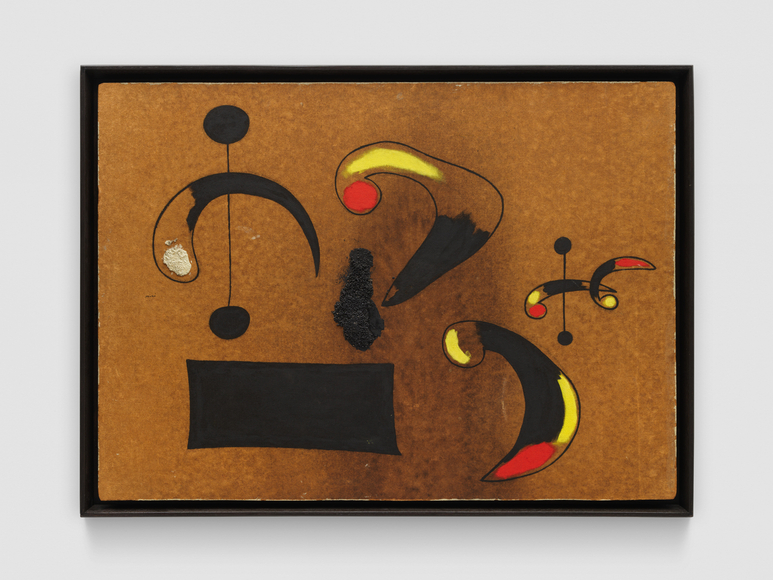
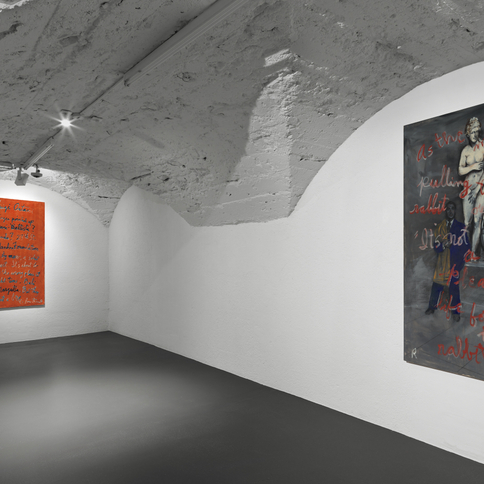
Vito Schnabel Gallery is pleased to present Joan Miró: The Assassination of Painting, opening on February 12, 2026 in St. Moritz. The exhibition brings together seven rare and significant works from Miró’s celebrated Masonite series. Executed in Spain during the summer of 1936, the Masonite paintings have been the subject of major exhibitions at the Museum of Modern Art, New York; Tate Modern, London; the Art Institute of Chicago; and the Fundació Joan Miró, Barcelona.
In 1927, Joan Miró famously declared his intention to “assassinate painting,” a provocation that would guide his artistic investigations over the following decade. The Masonite paintings represent the culmination of these explorations. Working directly on Masonite—a hard, industrial material recently invented in 1924 and traditionally used for construction—Miró rejected the conventions of canvas in favor of a raw, resistant surface that allowed for radical experimentation. Using oil, casein, tar, and sand, he created works of extraordinary material intensity, marked by rough textures, disjointed forms, and a profound sense of emotional and physical turbulence.
In the works, Miró deliberately left the hardboard support exposed, allowing its natural color to serve as both ground and compositional element. Against this coarse, absorbent surface, he articulated forms with fluid black lines, partially filling them with areas of color that appear suspended rather than fully resolved. Motifs recur across the series—arched rainbows formed by concentric curves, pendulum-like elements, X-shaped figures—creating visual echoes from one painting to the next. Miró conceived these works as sequences, likening them to frames of a cinematic progression, featuring symbolic elements such as figures, wires, and abstract signs. Their fractured landscapes and radically dismantled figuration convey both personal urgency and the broader instability of the historical moment.
Begun just days before the outbreak of the Spanish Civil War, the series is widely regarded as one of the most important bodies of work in Miró’s career, representing a pivotal moment of rupture and transition–they were the last works Miró produced in Spain before fleeing to Paris.
Joan Miró: The Assassination of Painting will be on view at the St. Moritz gallery until April 4, 2026.
For all inquiries, please contact: stmoritz@vitoschnabel.com
-
Joan Miró (b. 1893, Barcelona, Spain; d. 1983, Palma de Mallorca, Spain) was one of the most influential artists of the 20th century, known for his work as a painter, sculptor, ceramicist and printmaker. Born into a Catalan family, he began drawing at a young age and studied at La Lonja School of Fine Arts and later at the free-spirited Academy Gali in Barcelona, where he was encouraged to develop a deeply personal visual language influenced by Catalan folk art, primitive imagery and modern techniques. Early in his career he experimented with Fauvism and Cubism before finding his own voice that synthesized poetic abstraction, surreal fantasy and the subconscious, often using simplified forms, bright color and biomorphic shapes.
In the 1920s, Miró spent significant time in Paris, where he became associated with Surrealism, and by the 1930s his “dream pictures” and symbolic forms brought him international recognition. Over decades, he expanded his practice into murals, tapestries, ceramics and sculptures, creating public works and exploring diverse printmaking techniques. His mature art balanced a playful, childlike spirit with sophisticated experimentation and a deep connection to Catalan culture. Miró received numerous honors and his legacy is preserved in dedicated museums such as the Fundació Joan Miró in Barcelona.